Why Cheers is the Bold Retro Script Choice for Modern Designers
In a digital landscape saturated with clean sans-serifs and geometric grotesques, finding a typeface that commands attention while maintaining a sense of approachable fun can be difficult. This is where Cheers enters the conversation. It is not merely another display font; it is a deliberate stylistic statement designed to evoke the energy of a bygone era without feeling dated or clichéd. For designers aged 20 to 50 who are constantly evaluating tools to enhance their visual communication, understanding the specific utility of a retro bold script like Cheers is essential for making informed creative decisions.
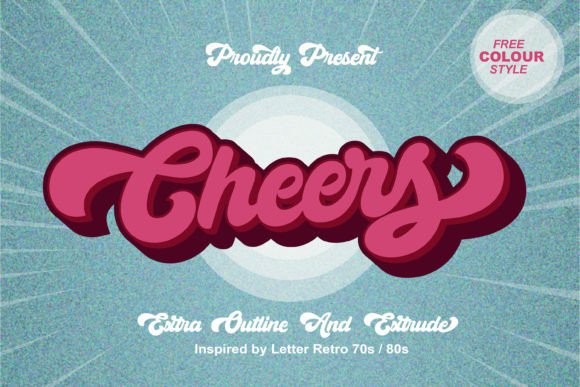
The distinct character of Cheers lies in its ability to balance vintage charm with modern usability. Unlike many script fonts that suffer from poor kerning or overly ornate details that clutter a design, Cheers offers a funky vibe that feels fresh. Its bold strokes provide immediate impact, making it an excellent candidate for headlines, posters, and branding elements that need to stand out in a crowded marketplace. The font's structure suggests movement and celebration, which aligns perfectly with projects requiring a touch of nostalgia or high-energy personality.
Distinguishing Features of the Cheers Typeface
What sets Cheers apart from standard serif or script families is its specific construction and the intentionality behind its glyphs. While many retro fonts attempt to mimic handwriting through erratic stroke widths and shaky baselines, Cheers maintains a consistent rhythm that ensures readability even at larger sizes. The bold weight gives it presence, allowing it to compete visually against heavy block letters or large photographic backgrounds.
A critical technical advantage of this font is its encoding. Cheers is PUA (Private Use Area) encoded, a feature that significantly enhances its functionality for professional workflows. In traditional font usage, accessing specific ligatures or alternate characters often requires complex workarounds or specialized software plugins. With PUA encoding, all unique glyphs and ligatures are mapped to accessible keys on your keyboard. This means you can easily insert decorative swashes, special punctuation, or alternative letterforms without leaving your design application. For a designer working under tight deadlines, this level of accessibility reduces friction and allows for rapid iteration on layout ideas.
The "funky" nature of the font also manifests in its irregularities. You will notice subtle variations in how the letters connect and interact. These imperfections are intentional, designed to break the monotony of rigid grid systems. When used correctly, these features add a layer of human touch to digital designs, making brands feel more authentic and less algorithmic. However, this stylistic choice does come with constraints that must be understood before adoption.
Comparative Analysis: Cheers vs. Standard Display Fonts
When evaluating Cheers against other options in the market, it is helpful to consider the spectrum of display typography. On one end, you have highly structured, geometric fonts that offer precision but lack soul. On the other, you have chaotic handwritten scripts that prioritize artistic expression over legibility. Cheers occupies a middle ground that is particularly valuable for commercial applications.
- Legibility vs. Style: Many competing script fonts sacrifice readability for flair. Cheers prioritizes the clarity of the letterforms while retaining its distinctive personality. This makes it suitable for longer headlines where a purely decorative font might become illegible.
- Versatility in Tone: While some retro fonts lean heavily into specific themes like 1920s speakeasies or 1950s diners, Cheers has a broader appeal. Its boldness allows it to fit into modern contexts such as tech startups looking for a playful edge or lifestyle brands seeking a nostalgic connection.
- Technical Implementation: As noted, the PUA encoding provides a workflow advantage over standard OTF or TTF files that require OpenType feature toggles. This difference is often overlooked until a project hits a snag, making Cheers a practical choice for professionals who value efficiency.
However, no single typeface is a universal solution. The decision to use Cheers depends heavily on the context of the project. If the goal is to convey corporate stability, minimalism, or high-end luxury, the bold and funky nature of Cheers might clash with the desired brand identity. In those scenarios, a cleaner, more neutral typeface would likely serve the message better.
Evaluating Strengths and Tradeoffs
Every design tool comes with a set of tradeoffs, and understanding them is key to effective selection. The primary strength of Cheers is its ability to generate instant mood. It acts as a shortcut to a specific emotional response, signaling fun, excitement, and informality. This is invaluable for event invitations, promotional banners, or social media graphics where capturing attention within seconds is crucial.
The tradeoff, however, lies in its limited range of weights and styles. Most comprehensive font families offer Light, Regular, Medium, Bold, and Black weights, along with italics and small caps. Cheers typically focuses on a singular, bold aesthetic. This means designers cannot easily create hierarchy within a body of text using only this font. It is strictly a display typeface. Attempting to use it for long-form content or dense paragraphs will result in visual fatigue and poor user experience.
Another consideration is compatibility across different platforms. Because of its PUA encoding, there may be instances where the font does not render correctly if the target audience does not have the font installed or if the file is converted to a format that strips private use mappings. While this is rarely an issue for static web images or print materials, it is a factor to consider for dynamic web environments where font embedding is required. Designers must ensure that the final output preserves the intended glyph mapping.
When to Choose Cheers Over Alternatives
Selecting the right font is often a matter of matching the tool to the task. Cheers is the ideal choice when the project requires a strong visual hook. Imagine a music festival poster, a craft beer label, or a retro-themed restaurant menu. In these cases, the font's bold lines and vintage flair are assets rather than liabilities. The PUA encoding becomes particularly useful here, allowing the designer to quickly swap out standard characters for stylized alternatives to create custom wordmarks without needing advanced graphic manipulation skills.
Conversely, if the project involves creating a cohesive brand system that spans multiple mediums, a more versatile family might be necessary. For instance, a fashion brand launching a full e-commerce site would likely need a font that works equally well in a navigation bar, a product description, and a marketing email. Cheers lacks the subtlety required for these smaller, functional elements. In such situations, a multi-weight sans-serif or a more restrained serif font would be a more prudent investment.
Furthermore, consider the longevity of the design. Trends in typography shift rapidly. While retro styles have enjoyed a resurgence, they can sometimes feel fleeting. Cheers captures a specific moment in retro design history. If the goal is to create a timeless piece that will remain relevant for a decade or more, relying solely on a trendy script font might date the work prematurely. A balanced approach often involves pairing Cheers with a classic, neutral typeface to anchor the design and provide contrast.
Practical Application Strategies
To get the most out of Cheers, designers should treat it as a supporting actor rather than the lead in every scene. Effective use involves strategic placement and thoughtful pairing. For example, using Cheers for a main headline paired with a simple, legible sans-serif for body copy creates a dynamic tension that draws the eye. The boldness of the script grabs attention, while the neutral companion ensures the information is consumed easily.
The PUA encoding feature should be leveraged to customize the design further. Instead of accepting the default letterforms, explore the available ligatures and alternates to create unique combinations. This customization adds a layer of exclusivity to the design, ensuring that the final output does not look generic. Whether it is adjusting the angle of a crossbar or selecting a more elaborate terminal, these small tweaks can elevate a standard layout into a bespoke creation.
Ultimately, the value of Cheers lies in its ability to inject personality into a design without overwhelming the viewer. It serves as a reminder that typography is not just about conveying text, but about setting a tone. By understanding its capabilities, limitations, and technical nuances, designers can make confident choices that enhance their projects. Whether you are revisiting vintage aesthetics or simply looking for a way to break the monotony of modern minimalism, Cheers offers a robust and accessible option that delivers on its promise of cool, retro bold style.