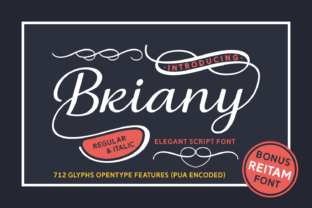
Briany: The Art of Integrating Vintage Script into Modern Design
In the rapidly evolving landscape of digital and print media, the search for a font that balances historical charm with contemporary sophistication is never-ending. Designers often struggle to find typefaces that offer the elegance of a handwritten script without sacrificing readability or professional credibility. This is where Briany emerges as a distinct solution. As a gorgeous, swashy script font, it provides a unique opportunity to infuse designs with a textured and vintage appeal while retaining a stylish and sleek vibe.
The versatility of this typeface allows it to transcend specific niches, making it relevant for a broad spectrum of users ranging from corporate strategists to independent hobbyists. Whether you are crafting a brand identity for a boutique bakery, designing an educational module for art history, or creating a high-end marketing campaign, understanding how to leverage the characteristics of Briany can elevate the visual narrative of your project.
Defining the Aesthetic: Texture and Flow
To truly appreciate the utility of Briany, one must first understand its visual DNA. Unlike rigid geometric sans-serifs or standard serif fonts, Briany mimics the organic movement of calligraphy. The "swashy" nature of the letters refers to the decorative flourishes that extend from the ascenders and descenders, creating a sense of motion and fluidity. These elements are not merely ornamental; they serve to guide the eye across the page, establishing a rhythm that static fonts cannot achieve.
The "textured" aspect mentioned in its description is crucial for modern web design, which often suffers from being too sterile or flat. By introducing a font with inherent character, designers can add depth to their layouts. When used in headlines, Briany acts as a focal point, drawing immediate attention. However, its strength lies in its ability to remain legible even when stylized. This balance between artistic flair and functional clarity is what makes it a preferred choice for professionals who need to make a statement without confusing their audience.
- Fluid Ligatures: The connections between letters create a continuous flow, reducing visual gaps and enhancing readability in short phrases.
- Vintage Flourishes: Subtle curves and extended strokes evoke a mid-century or Victorian aesthetic, depending on the context.
- Sleek Proportions: Despite the decorative elements, the core structure remains tight and modern, preventing the text from looking dated or cluttered.
Practical Applications Across Industries
The true value of any typeface is measured by its adaptability. Briany is not limited to a single industry; rather, it serves as a bridge between traditional aesthetics and modern communication needs. Below are several key sectors where this font demonstrates exceptional utility.
Branding and Identity for Lifestyle Businesses
For business owners in the hospitality, fashion, and wellness sectors, the visual tone of a brand is paramount. A coffee shop aiming for a cozy, artisanal feel might struggle to convey warmth using standard corporate fonts. Here, Briany offers a perfect fit. Its vintage appeal suggests heritage and craftsmanship, qualities that consumers highly value. Imagine a logo for a craft brewery or a wedding planning service; the swashy script immediately communicates elegance and personal care. It transforms a simple name into a story before a single word of copy is read.
Educational Materials and Creative Workshops
Educators and researchers often face the challenge of making content engaging for diverse learners. While body text should generally remain neutral to ensure comprehension, headers and section dividers provide an excellent canvas for personality. In educational materials focusing on history, literature, or the arts, using Briany for titles can set an appropriate mood. For instance, a syllabus for a creative writing course could use Briany to inspire students, suggesting that creativity is central to the curriculum. It adds a layer of tactile experience to digital documents, making them feel more like books than spreadsheets.
Digital Marketing and Content Creation
Content creators, including bloggers and social media influencers, constantly battle for attention in crowded feeds. Visual hierarchy is essential, and typography plays a massive role in this. A headline featuring Briany stands out against a background of standard body text. Because the font retains a sleek vibe, it avoids the "cluttered" look that can occur with overly ornate scripts. This makes it ideal for email subject lines, blog post titles, and promotional banners where click-through rates depend on immediate visual impact.
Strategic Implementation and Workflow
Integrating a script font like Briany into a design workflow requires a strategic approach. It is not simply a matter of selecting the font and applying it everywhere. To maintain the integrity of the design, one must consider contrast, pairing, and spacing.
The most effective strategy involves pairing Briany with a clean, neutral sans-serif or a classic serif for body text. If the headline is elaborate, the supporting text must be understated to prevent visual competition. This creates a balanced composition where the script font acts as the star, while the body text ensures the message is easily digestible. For example, a designer might use Briany for the main title of a poster and a lightweight Helvetica for the event details. This juxtaposition highlights the unique characteristics of Briany while ensuring the information remains accessible.
- Analyze the Brand Voice: Determine if the vintage, swashy aesthetic aligns with the organization's values. If the brand is strictly utilitarian or tech-focused, this font may be inappropriate.
- Select the Right Weight: Many script families come in various weights. Choose a weight that matches the medium; thinner weights work well for delicate backgrounds, while bolder weights are better for high-impact signage.
- Mind the Spacing: Scripts often require slightly tighter tracking (letter-spacing) than block fonts to maintain cohesion. Adjust kerning carefully to ensure the ligatures do not collide awkwardly.
- Test for Legibility: Always test the font at different sizes. What looks beautiful at 72 points may become illegible at 10 points. Reserve Briany primarily for headlines, subheads, and short captions.
The Psychology of Typography in Consumer Engagement
Understanding why Briany works goes beyond aesthetics; it touches on consumer psychology. Fonts carry emotional baggage and associations. Serifs often denote trust and tradition, while sans-serifs suggest modernity and efficiency. Script fonts, particularly those with a vintage texture, evoke nostalgia, intimacy, and human connection. They mimic the human hand, which subconsciously signals authenticity to the viewer.
In an era where digital interactions can feel impersonal, using a font that feels "hand-crafted" can break down barriers. When a consumer sees Briany on a packaging label or a website header, they perceive a level of effort and care that mass-produced fonts lack. This perception can influence purchasing decisions, particularly in markets where quality and uniqueness are selling points. The "sleek vibe" mentioned in the font's profile ensures that this nostalgia does not drift into the realm of the old-fashioned; instead, it feels curated and intentional.
Considerations for Researchers and Developers
While Briany is visually striking, technical considerations must be addressed by developers and researchers working on digital accessibility. Not all script fonts render well on all devices, especially smaller screens or older operating systems. The swashes and complex curves can sometimes cause rendering issues if the font file is not optimized.
Furthermore, accessibility standards (such as WCAG) emphasize readability. Using a script font for long-form content is generally discouraged because the varying stroke widths and connected letters can strain the eyes during prolonged reading. Therefore, the best practice is to limit Briany to display purposes. For research papers or technical documentation, it should only be used for titles to add a touch of style without compromising the rigor of the content. This approach respects the E-E-A-T (Experience, Expertise, Authoritativeness, Trustworthiness) principles by prioritizing user experience and clarity over mere decoration.
Trends Shaping the Future of Display Type
The design world is currently experiencing a resurgence of interest in retro styles. We are seeing a shift away from the ultra-minimalist trends of the early 2010s toward more expressive and textured designs. Consumers are craving individuality and character in their digital experiences. Fonts like Briany are at the forefront of this movement, offering a way to inject personality into websites and applications.
This trend is not just about looking back; it is about blending the past with the future. The "sleek" attribute of Briany ensures it fits seamlessly into modern interfaces that utilize dark modes, glassmorphism, and bold color palettes. As brands strive to differentiate themselves in saturated markets, the ability to choose a font that conveys both history and modernity becomes a competitive advantage. Designers who master the art of pairing such fonts will continue to lead the charge in creating memorable visual identities.
Conclusion on Visual Impact
The journey through the world of typography reveals that every letter tells a story. Briany is a storyteller in itself, weaving together threads of vintage charm and modern refinement. Its gorgeous, swashy script nature makes it a powerful tool for anyone looking to add texture and soul to their designs. From the boardroom to the classroom, from the e-commerce site to the local bakery, the application of this font can transform the mundane into the magnificent.
By adhering to the principles of thoughtful implementation—pairing wisely, respecting legibility, and understanding the psychological impact of type—professionals and hobbyists alike can harness the full potential of Briany. It is more than just a font; it is a design element that invites engagement, evokes emotion, and elevates the overall quality of communication. As the digital landscape continues to evolve, the demand for fonts that offer both style and substance will only grow, cementing the place of Briany as a staple in the modern designer's toolkit.